

2026 AI Search Visibility: Which Platforms Are Brands Visible On?
By Franixo · · 6 minutes read
AI search visibility has become an increasingly important topic for brands in 2026. As artificial intelligence continues to evolve, search behavior is undergoing a fundamental transformation.
Users are no longer shaping their purchasing decisions and industry research solely through traditional search engine queries. They are increasingly turning to generative AI systems such as ChatGPT, Perplexity, Claude, Gemini, and Google AI Overviews.
So how visible are brands within this new Generative Engine ecosystem? Does having a strong presence in Google's organic search results necessarily mean that a brand will also be recommended by AI models?
As the Franixo research team, we analyzed brand performance across AI search engines based on anonymized industry search queries processed through our platform. This report presents concrete data on brand presence across the B2B SaaS, FinTech, E-commerce, and Enterprise Services sectors, highlighting cross-platform visibility gaps and citation dynamics.
Key AI Search Visibility Statistics
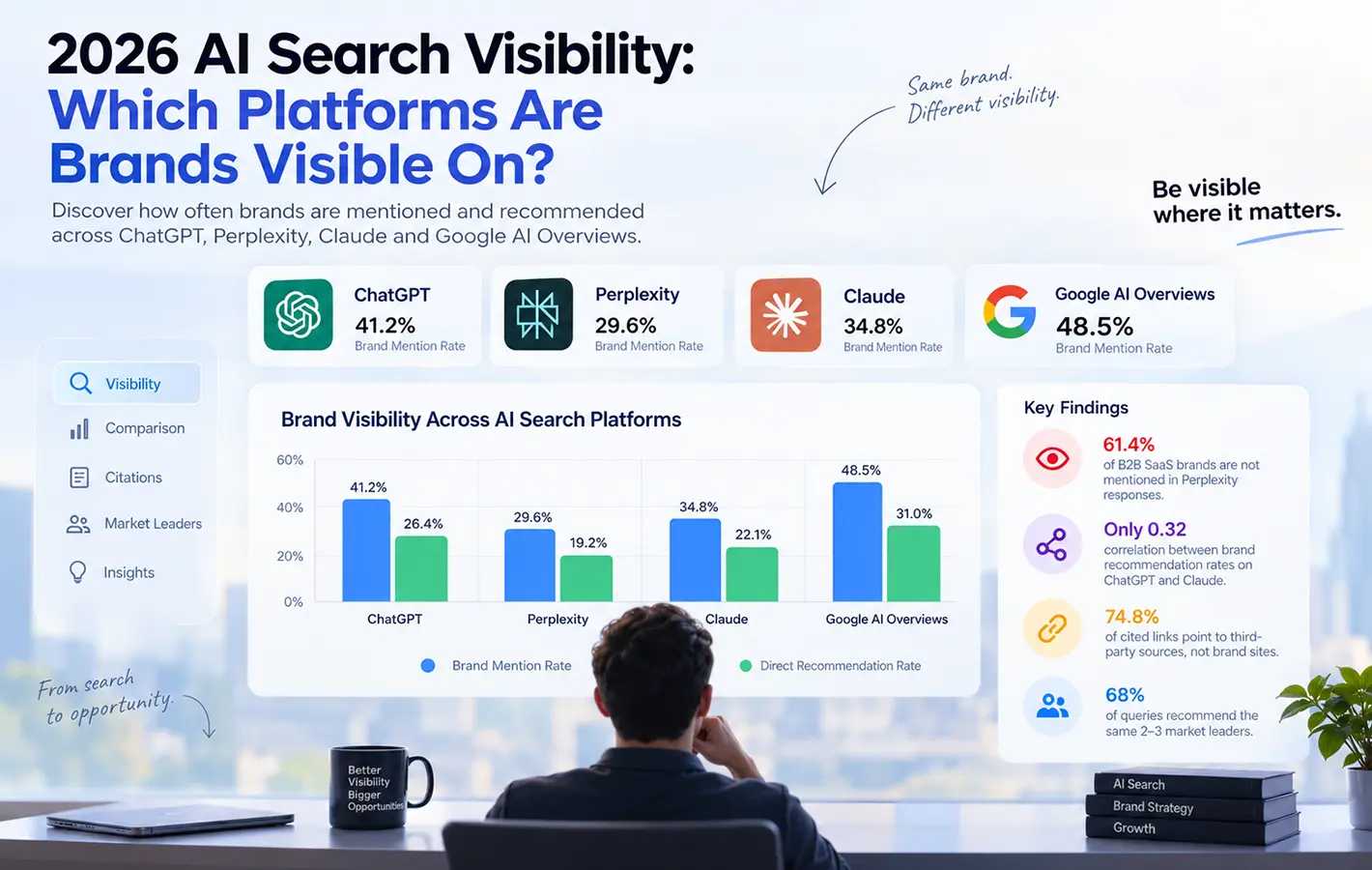
- The Perplexity Blind Spot: 61.4% of the B2B SaaS brands analyzed fall behind their competitors or are not mentioned at all in Perplexity responses, despite ranking on the first page of Google organic search.
- Cross-Platform Inconsistency: The correlation between a brand's recommendation rate on ChatGPT and its recommendation rate on Claude is only 0.32. A brand may have strong visibility on one platform while being completely invisible on another.
- Third-Party Dominance: 74.8% of the links cited in AI-generated recommendations do not point to brands' own websites. Instead, they refer to independent review platforms, industry reports, and user communities.
- Recommendation Concentration: In 68% of analyzed queries, AI models repeatedly recommend the same two or three dominant market leaders within the top three positions. Mid-sized and innovative solutions often fail to enter the recommendation pool due to a lack of sufficient information consensus.
Cross-Platform Comparison: Where Are Brands Visible — and Where Are They Not?
Each AI model relies on different information architectures, indexing methods, and weighting algorithms. For this reason, it is not possible to assign a brand a single universal "AI Score." Visibility can vary dramatically from one platform to another.
Cross-Model Performance Comparison Matrix
| Metric / Platform | OpenAI (ChatGPT) | Perplexity | Anthropic (Claude) | Google AI Overviews |
|---|---|---|---|---|
| Average brand mention rate | 41.2% | 29.6% | 34.8% | 48.5% |
| Direct recommendation rate | 26.4% | 19.2% | 22.1% | 31.0% |
| Average external sources / citations | 2.8 | 6.4 | 1.2 | 4.6 |
| Reliance on community sources | Medium (34%) | Very high (58%) | Low (16%) | High (47%) |
| Static data vs. live search weighting | Balanced | Real-time focused | Model-training weighted | Search-index supported |
Perplexity: Where B2B SaaS Brands Lose the Most
One of the most striking findings of our research is that 61.4% of brands in the B2B SaaS category are losing the visibility race on Perplexity.
Why are they losing? When generating answers, Perplexity heavily scans its live web index, particularly in-depth technical documentation, GitHub repositories, Reddit discussions, and third-party directories such as G2 and Capterra.
The core problem: Brands that rely primarily on marketing-focused landing pages and lack independent technical comparisons on third-party sources often fail to pass Perplexity's "verifiable evidence" filter.
OpenAI (ChatGPT): Information Consensus and Brand Volume Pressure
With its extensive training dataset and search integrations, ChatGPT operates at one of the largest scales in the AI search ecosystem.
Finding: A brand's likelihood of being recommended on ChatGPT is positively associated with the overall volume of online mentions and entity co-occurrence across the web.
Risk: The model tends to favor established and well-known brands, creating what can be described as an incumbency bias. For innovative products or solutions offering a strong price-to-performance advantage to enter ChatGPT responses, being mentioned in press releases alone may not be sufficient. They also need visibility in industry analyst reports and authoritative third-party sources.
Anthropic (Claude): Filtering Marketing Clichés
Claude uses a synthesis approach that prioritizes analytical depth and balanced evaluation.
Finding: Claude tends to avoid using highly promotional content or exaggerated claims such as "the best," "number one," or "unmatched" as supporting sources.
Opportunity: Brands that share transparent data and publish neutral case studies that openly discuss both strengths and weaknesses achieved a 38% higher citation rate on Claude compared with their competitors.
Google AI Overviews: The Weakening Link Between Organic Ranking and AI Visibility
Google AI Overviews represents one of the most significant areas of transformation in search engine optimization. Within Franixo Features, this surface is monitored independently from standard Gemini models as a separate search environment.
Finding: 58.6% of the sources used by AI Overviews come from websites that rank outside the top five positions in traditional organic search results.
Conclusion: Leadership in traditional SEO does not guarantee visibility within Google AI Overviews.
Why Are Brands Invisible in AI Search? Three Structural Reasons Brands Are Ignored by AI
There are three common strategic problems behind poor brand visibility across AI search engines.
The Single-Domain Bias
Many marketing teams invest nearly all of their resources into optimizing content on their own websites. However, from an LLM's perspective, a single domain does not provide sufficient evidence of credibility. For a brand to be recommended by AI systems, it also needs a presence across the wider external ecosystem, including review platforms, news and media publications, podcast transcripts, and industry directories.
The Citation Gap
If your competitors appear in the primary reference sources used by AI systems — for example, industry comparison platforms frequently cited by Perplexity — while your brand does not, the model may naturally perceive your competitor as the more established or valid option. Once this pattern becomes established, it can become difficult to reverse due to model training cycles and caching mechanisms.
Low Extractability
Content that is written with excessive corporate jargon, lacking clear definitions, buried inside PDFs, or filled with overly promotional language may be filtered out by AI crawlers and RAG (Retrieval-Augmented Generation) systems. AI models tend to prefer information that can be directly extracted and converted into answers, such as clear statistics, bullet-point comparisons, structured information, and explicit data formats.
AI Visibility Action Plan for Brands: A GEO Roadmap with Franixo
Traditional SEO metrics such as rankings, search volume, and organic traffic now represent only part of the picture. Marketing leaders should expand their strategies with the following four-step action plan:
- Measure your multi-platform visibility. Regularly track how often your brand is mentioned and recommended not just on a single AI model, but across ChatGPT, Claude, Perplexity, and Google AI Overviews using Franixo.
- Break down competitor share of voice. Analyze the queries in which your competitors achieve higher recommendation rates than your brand. This allows you to identify where competitors dominate the AI-generated conversation and where your visibility gaps exist.
- Identify citation gaps. Use the Citation Opportunities tool within Franixo Features to identify third-party sources that AI models reference when recommending your competitors but where your own brand is not yet present. Then direct your PR and content operations toward these sources.
- Apply evidence-based optimization. Use weekly automated scans to determine whether your content improvements and citation-building efforts are actually being recognized by AI models.