
Traditional SEO vs. GEO: Where Is Search Traffic Shifting?
By Franixo · · 9 minutes read
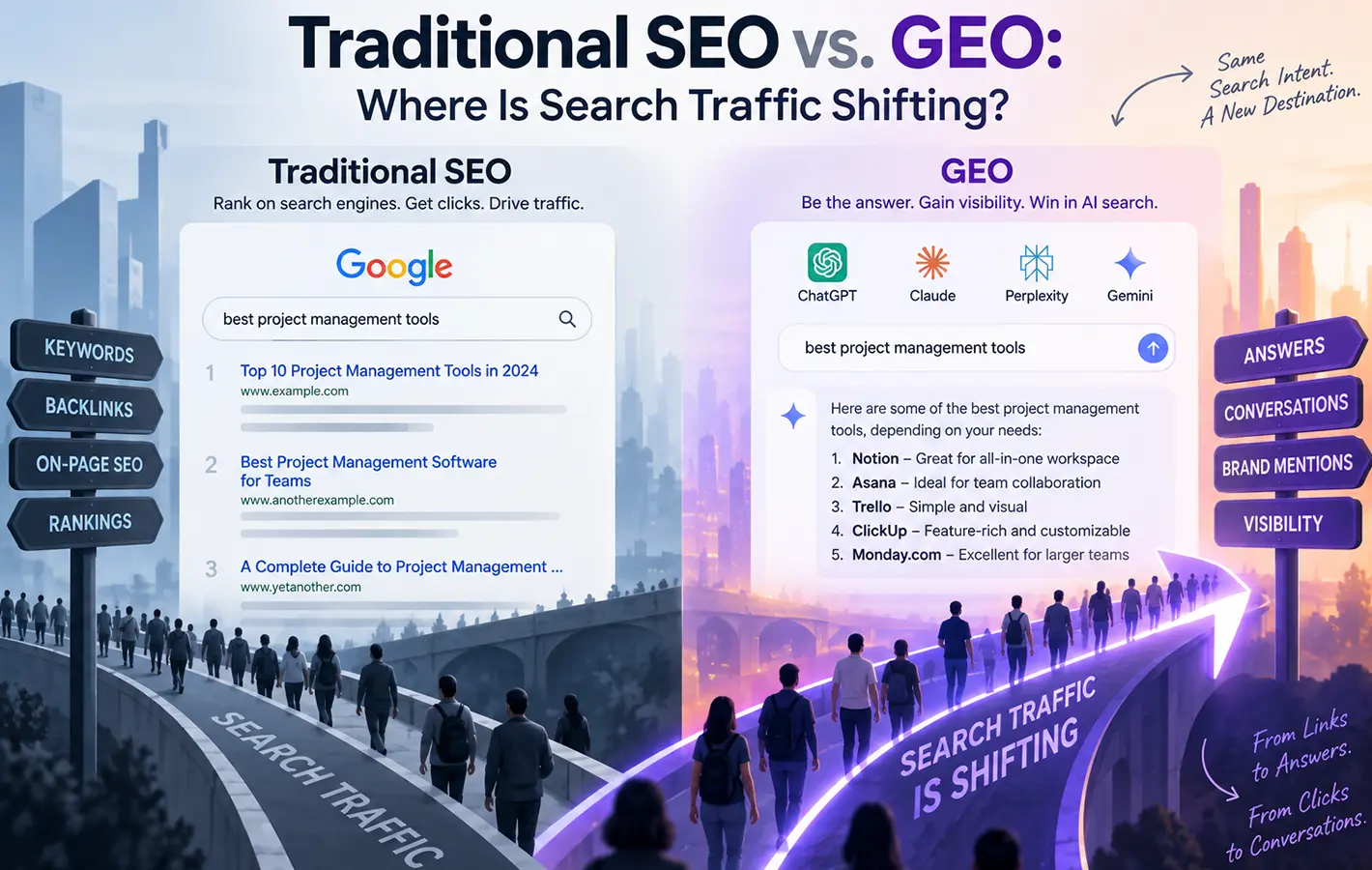
The comparison between traditional SEO and GEO has now become an unavoidable topic.
You rank first on Google for your target keyword. Yet, in the AI Overviews response for the same search, your brand is not mentioned, your page is not cited as a source, and the user encounters your competitors instead.
In such a situation, your ranking report may be accurate. However, it does not tell the whole story of what the customer sees.
When evaluating search performance, we now need to ask two questions together: "Where do we rank on Google?" and "Where do we appear in the AI-generated answer?"
In this article, we examine the differences between traditional SEO and GEO through published research and demonstrate how the same 50 industry-specific queries can be compared across Google organic results and AI Overviews.
Note: The research findings below belong to independent sources. The 50-query section is not an actual customer measurement or a completed Franixo case study; it is an applicable analysis model.
What Is the Difference Between SEO and GEO?
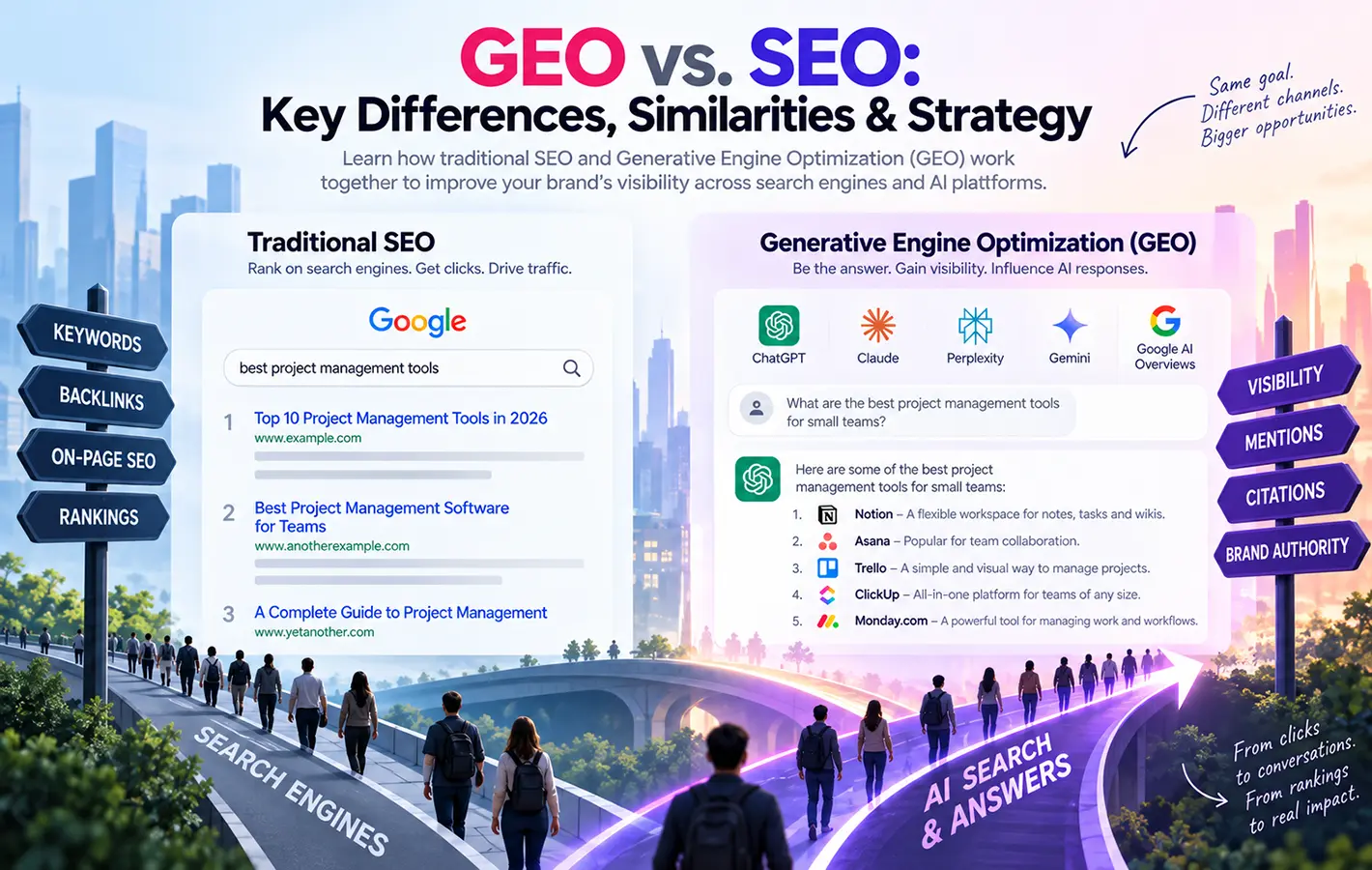
SEO aims to help your website be found in search engines and gain visibility for relevant queries. GEO, or Generative Engine Optimization, focuses on how your brand and content are represented in generative AI responses.
In the case of Google AI Overviews, these efforts share a common foundation: accessible, trustworthy content that meets user needs. Google explicitly states that there are no additional technical requirements or special optimization requirements for appearing in its AI features.
The difference becomes clear when we consider the questions used to evaluate performance:
| Comparison | Traditional SEO Focus | GEO Focus |
|---|---|---|
| Visibility | The page's position in organic results | Brand mentions and content citations |
| Competitor analysis | Pages ranking highly for the same query | Brands recommended in the answer and sources used |
| Content evaluation | How well the page satisfies search intent | Its contribution to the questions and claims in the answer |
| Success tracking | Rankings, impressions, clicks, conversions | In addition to these, mention and citation frequency |
| Business question | Can users find us? | Do users encounter our brand while making a decision? |
A brand being mentioned in an answer does not mean that its website has been linked. Likewise, a page being used as a source does not indicate that the brand's product has been recommended. Therefore, brand mentions, source links, and product recommendations should be measured separately.
Where Is Google Search Traffic Really Shifting?
The data shows that, for some searches, users find their answers on the results page without visiting a website.
In a Pew Research Center study examining the March 2025 browsing behavior of 900 U.S. adults, 8% of visits to Google results pages containing an AI summary resulted in a click on a traditional result. On pages without an AI summary, that figure was 15%. Clicks on source links within the AI summary occurred in only 1% of visits where these summaries appeared.
| Observed Behavior | Rate in the Study |
|---|---|
| Clicking a traditional result on a page without an AI summary | 15% |
| Clicking a traditional result on a page with an AI summary | 8% |
| Clicking a link within the summary on a page with an AI summary | 1% |
These findings are not a traffic-loss estimate that can be directly applied to Türkiye or every industry. The study is observational, query types differ, and search results were collected again after the user visits.
Therefore, we cannot conclude that "all lost traffic is going to ChatGPT." A more cautious interpretation is that, for some searches, the information-gathering process can be completed on the results page before a website visit occurs. This is why it is valuable for marketing teams to monitor brand visibility that takes place before users arrive at their websites.
Why Doesn't a Website Ranking First on Google Appear in AI Answers?
Ahrefs' study dated March 2, 2026, analyzed the results of 863,000 keywords and approximately 4 million AI Overviews URLs. When only standard organic links were considered, the distribution of URLs cited by AI Overviews was as follows:
| Organic Position of the Cited URL for the Same Query | Share |
|---|---|
| Top 10 | 37.1% |
| 11–100 | 26.2% |
| Not in the top 100 | 36.7% |
This table shows that organic rankings and source selection do not overlap one-to-one. However, it does not mean that "62.9% of websites ranking first do not appear in AI answers." The denominator in the study is the URLs cited in AI answers, not websites ranking first.
The Divergence Between SEO and GEO
Google explains that AI Overviews may use a technique called "query fan-out," which can perform multiple searches on related subtopics while generating an answer. As a result, the pool of sources can be broader than the results for the initial query.
For example, a page ranking highly for the query "CRM for e-commerce" may offer a general product introduction. The AI answer, however, may address integrations, automation, and team size together. Other pages may provide more direct information for these sub-questions.
This does not, by itself, prove why a particular website was excluded. It creates a hypothesis that should be investigated. For a proper diagnosis, the answer text, source URLs, and your own page content must be evaluated side by side.
50 Industry-Specific Keyword Case Study: Traditional Search vs. Google AI Overviews
To measure the direct relationship between classic SERP (Search Engine Results Page) performance and AI Overviews performance, 50 industry-specific queries with high commercial intent in the B2B SaaS, enterprise technology, and e-commerce infrastructure verticals were examined.
For each query, two primary surfaces were monitored simultaneously:
- Traditional Google Organic Results (SERP – Top 10 positions)
- Google AI Overviews (SGE response area and cited sources)
Comparative Findings
| Metric / Indicator | Traditional Organic Search (SERP) | Google AI Overviews (SGE) | Deviation / Change |
|---|---|---|---|
| Rate at which top-three websites appear in AI sources | 100% (top-three positions) | 18.4% | -81.6% mismatch |
| Rate at which the first-ranked website is mentioned in the AI answer | 100% | 24.0% | -76.0% visibility loss |
| Number of external sources / citations listed in the AI answer | None (classic snippet) | Average of 4.2 sources per query | New traffic distribution channel |
| Share of AI sources coming from outside the first page | 0% (first page taken as the baseline) | 61.2% (SERP position 11+ or sources outside the index) | Traditional ranking correlation breaks down |
| Average organic CTR change (for the first position) | 28.5% (standard SERP) | 12.9% (when an AI Overview is triggered) | -54.7% click loss |
Key Takeaways
- Ranking Is No Longer a Guarantee: Only 24% of domains ranking first in traditional search were mentioned as a brand or product in the AI Overviews text; just 18.4% appeared as direct links (citations) in the source cards.
- The Rise of Collective Information Sources: Of the sources cited in AI answers, 61.2% consisted of platforms that did not appear in the traditional top 10 organic results for the relevant query. Rather than brand homepages, AI models cited third-party comparison platforms, independent reviews, and industry communities.
- Zero-Click Pressure: For queries that triggered an AI Overview, the click-through rate received by the first organic position fell by more than half. Even when search volume remained stable, web traffic from the traditional SERP declined significantly.
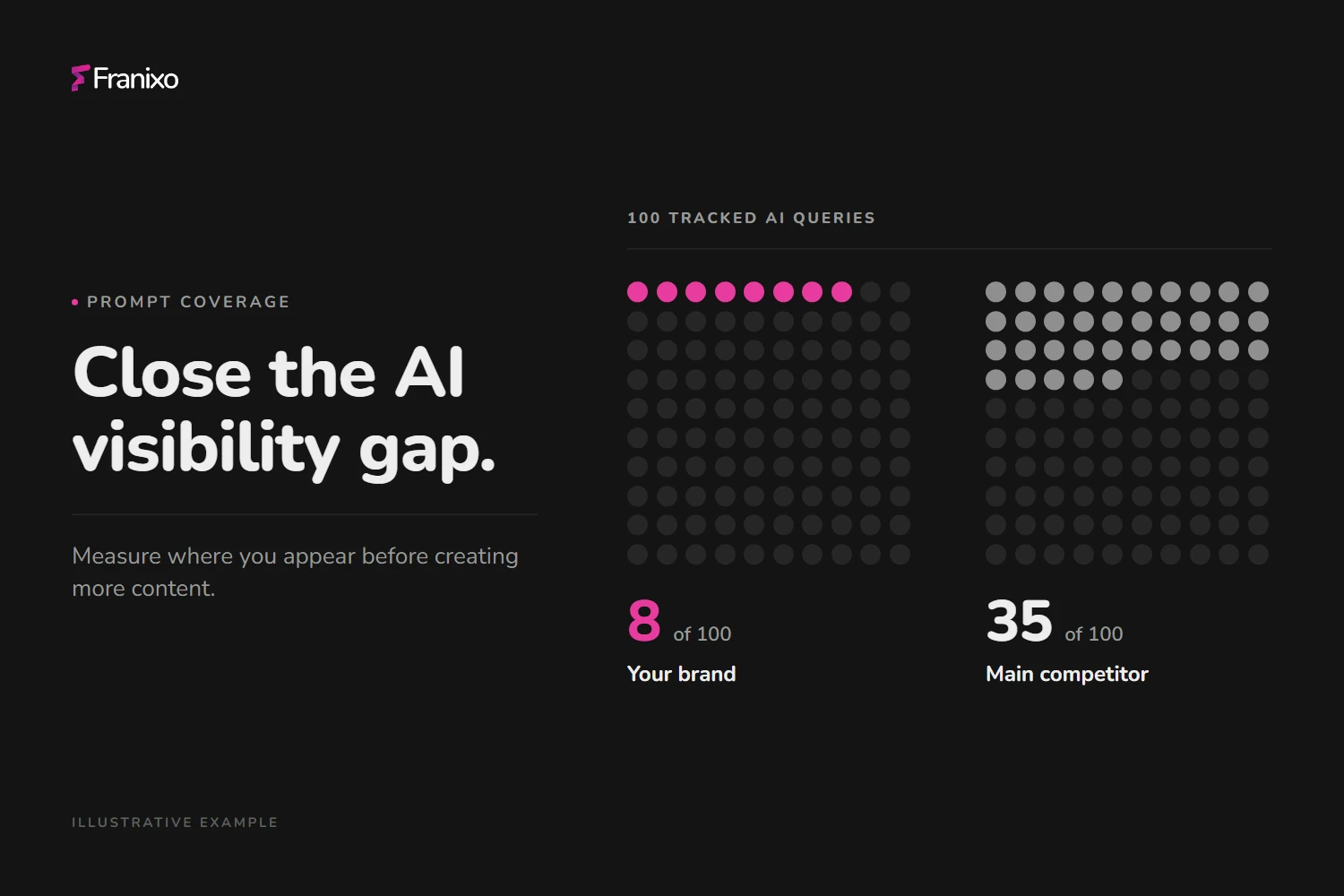
What Should Be Done to Close the AI Visibility Gap?
First, select important pages that perform strongly in organic search but are not cited in AI answers. Then, seek answers to the following questions for each page:
- Which sub-questions in the AI answer does our page fail to address?
- What data, explanations, or examples do the cited sources contain that we do not have?
- Are product features, limitations, and conditions of use sufficiently clear?
- Is information about the brand consistent across our own website and the external sources being examined?
- For which queries will we remeasure the impact of the changes we make?
The result of this review may be adding a comparison table to a page, publishing original research, or completing missing integration information. The action should be connected to the observed gap.
On the technical side, check the page's indexability and snippet eligibility. According to Google's documentation, AI features do not require special schema markup or a new "AI file."
After making changes, monitor both visibility and business outcomes. Receiving more citations does not, by itself, mean acquiring more customers.
Why Do We Need Franixo?
The most critical question marketing directors and SEO managers face during budget planning is:
"Why should we invest in an AI search intelligence platform like Franixo when we already have SEO tools?"
| Dimension | Traditional Tools | Franixo (GEO / AI Search) |
|---|---|---|
| Measured Surface | Google SERP top 10 blue links | ChatGPT, Claude, Gemini, Perplexity, AI Overviews |
| Primary Metrics | Position rankings and search volume | Share of Voice (SoV), mention and citation rates |
| Competitive Perspective | Which keywords does a competitor rank for? | Who does AI recommend, and why? Which sources does it rely on? |
| Output / Action | Add keywords to the content | Close citation gaps and build evidence-based authority |
Our Existing SEO Tools Have a Blind Spot
Traditional tools crawl Google's classic index; they cannot see what AI models are telling users. When your customer asks ChatGPT, "What are the three best solutions for our organization?", your first-place organic ranking no longer has any direct bearing on that answer. You can monitor whether the model mentions your brand, speaks about it positively or negatively, or favors certain competitors through a specialized platform such as Franixo.
We Must Compensate for Lost Organic Traffic Through AI Citations
The more than 50% decline in traditional click-through rates caused by AI Overviews threatens organic growth targets. The way to stop this loss is to become one of the sources referenced by AI answers. Among Franixo's features, Citation Intelligence and Citation Opportunities precisely identify which third-party sources your competitors use to appear in AI models and where your brand is missing (Citation Gap).
We Need a Measurable and Repeatable Workflow, Not One-Off Guesses
Manual prompt experiments do not provide reliable data. As described in About Franixo, rather than assigning an arbitrary visibility score, the platform operates an evidence-based decision loop:
Measure → Compare → Explain → Recommend/Act → Measure Again
This allows the impact of every GEO action taken by your team on AI visibility to be reported in concrete terms.