
GEO vs SEO: Key Differences, Similarities & Strategy
By Franixo · · 18 minutes read
Search is changing. For years, brands built organic visibility around a familiar model: someone searches for a keyword, a search engine returns a ranked list of results, and the user chooses which page to visit.
Generative AI is adding another layer to that journey.
People can now ask ChatGPT, Gemini, Perplexity, Claude, Google AI Mode and other AI-powered experiences questions such as "What are the best project management tools for agencies?", "Which CRM is best for a small ecommerce business?" or "What are the top alternatives to this brand?"
Instead of returning only a list of links, generative systems can synthesize information, compare options, mention brands, recommend products and cite supporting sources.
That shift has introduced a new optimization discipline: Generative Engine Optimization, or GEO.
But does GEO replace SEO? Not quite.
SEO and GEO overlap heavily, but they focus on different visibility surfaces, different user experiences and, importantly, different ways of measuring success.
In this guide, we'll break down GEO vs SEO, where they differ, where they overlap and how brands can build a strategy that improves visibility across both traditional search and AI-generated answers.
What Is SEO?
Search Engine Optimization (SEO) is the practice of improving a website's visibility in organic search results.
The goal is to make relevant pages easier for search engines to discover, understand, index and surface when users search for information, products or services related to the business.
Modern SEO goes far beyond keyword placement. It includes technical SEO, search intent research, content optimization, internal linking, site architecture, structured data, digital PR, backlinks, brand signals and page experience.
Search engines increasingly try to understand what users actually want to accomplish rather than simply matching pages with exact keywords.
How Traditional SEO Works
At a simplified level, traditional organic search follows a process such as:
Crawl → Index → Understand → Rank → Display → Click
A search engine discovers a page, processes its content and signals, determines which queries it may be relevant for and decides whether to display it in a search result.
For example, someone searching for "best AI visibility tools" may see comparison articles, software landing pages, reviews and category pages.
The publisher's objective is usually to earn enough relevance and authority to appear prominently for that search intent.
What SEO Measures
SEO performance can be evaluated using several different signals. The most common include organic impressions, clicks, keyword rankings, conversions, indexed pages, backlinks and referring domains.
Ranking position is only one part of the picture.
A page ranking first without generating qualified traffic or conversions may ultimately be less valuable than a lower-ranking page that attracts users with stronger buying intent.
What Is Generative Engine Optimization (GEO)?
Generative Engine Optimization (GEO) is the practice of improving how a brand, product, entity or piece of content is discovered, understood, mentioned, recommended or cited within generative AI experiences.
While SEO typically focuses on search result visibility, GEO expands the measurement question:
When someone asks an AI system a question relevant to our market, does our brand appear in the answer?
If the answer is yes, the next questions become more specific. How often is the brand mentioned? Is it actually recommended? Where does it appear relative to competitors? Which sources support the response? Does that visibility remain consistent across different AI platforms?
This turns AI search visibility into something that can be monitored rather than treated as an occasional screenshot.
How GEO Works
A simplified generative search journey can look like this:
Prompt → Retrieval / Context → Source Evaluation → Synthesis → AI Response → Citation / Mention / Recommendation
The exact process varies significantly between AI systems.
Some experiences rely heavily on live web retrieval. Others combine web information with search infrastructure, proprietary indexes, model knowledge and different retrieval systems.
That is why GEO should not be treated as a single universal ranking algorithm.
There is no guaranteed formula such as "do these five things and ChatGPT will rank your company first."
Instead, GEO is better approached through a combination of strong search fundamentals, clear entity information, authoritative content, third-party presence, citable information and continuous visibility measurement.
What GEO Measures
GEO introduces another group of visibility metrics.
These can include:
- AI Visibility Score
- Brand Mention Rate
- Recommendation Rate
- Share of Voice
- Average Position
- Citation Presence
- Competitor Visibility
- Cross-Provider Visibility
- Historical Visibility Change
These metrics should not be interpreted as permanent AI rankings.
Generative responses can change based on model versions, retrieval systems, prompt wording, geography, freshness and other variables.
For that reason, GEO measurement works best when based on consistent prompt sets and recurring observations over time.
GEO vs SEO: Key Differences
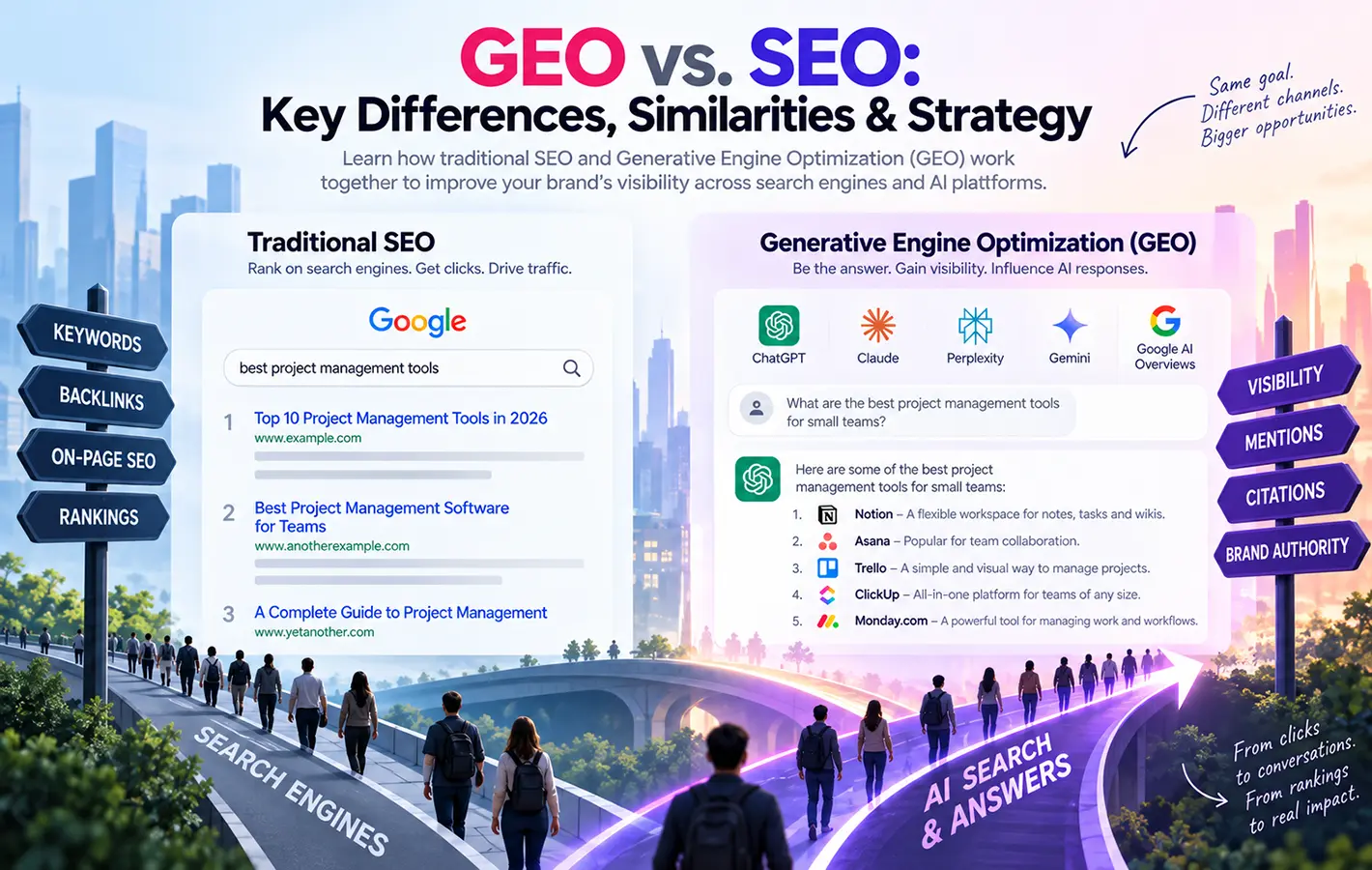
SEO and GEO share many foundations, but the environments they measure are different.
Search Results vs AI-Generated Answers
Traditional SEO primarily deals with search result pages.
A user searches for:
best CRM software for startups
and receives a set of results they can evaluate individually.
Generative AI can instead produce a synthesized answer containing several recommended products, explanations and supporting sources.
The brand may therefore become visible without the user first seeing a traditional blue-link search result.
That creates a new visibility surface.
The objective is no longer limited to:
"Does my page rank?"
It also becomes:
"Does my brand become part of the generated answer?"
Rankings vs Mentions and Recommendations
SEO commonly uses ranking positions as a visibility metric.
For example:
- Keyword: AI visibility tool
- Position: 4
GEO is less linear.
For one prompt, a brand might not appear at all. In another response, it may be briefly mentioned. In another, it may be actively recommended or appear first among several alternatives.
This makes metrics such as Mention Rate, Recommendation Rate, Average Position and AI Share of Voice useful for identifying patterns across multiple responses.
Backlinks vs Citations
Backlinks and AI citations should not be treated as direct replacements for one another.
A backlink is a link from one web page to another.
An AI citation usually refers to a source displayed or referenced by an AI-powered experience to support part of its generated answer.
A website may have strong backlink authority without being frequently cited by a particular AI system. At the same time, a niche page can sometimes appear as a citation because it provides highly relevant information for a specific question.
For brands, this creates an additional strategic question:
Which sources are influencing AI-generated conversations in our category?
Understanding those sources can reveal content gaps, digital PR opportunities and competitor citation patterns.
Keywords vs Prompts
SEO marketers traditionally organize research around keywords and search queries.
GEO introduces prompts as another important measurement unit.
Consider the keyword:
project management software
Users interacting with an AI assistant may express that intent in many different ways:
- What is the best project management software?
- Which tool is best for agencies?
- Compare Asana, ClickUp and Monday.
- Which platform has the best client collaboration features?
A strong GEO strategy therefore looks beyond a single keyword and considers the wider decision-making conversations surrounding the topic.
This does not make keywords obsolete.
Keywords remain useful for understanding demand, terminology and search intent. Prompts simply expand that research into more conversational and contextual situations.
Organic Traffic vs AI Visibility
Traditional SEO is strongly associated with generating organic website traffic.
GEO adds another layer: visibility inside AI responses.
A user may encounter a brand in an AI answer without immediately clicking through to its website.
That means measurement increasingly needs to consider more than sessions alone.
Relevant GEO indicators can include AI mentions, recommendations, citations, Share of Voice, AI referral visits and visibility changes over time.
Ultimately, both SEO and GEO should still connect to meaningful business outcomes.
Visibility for its own sake is not the goal.
GEO vs SEO Comparison Table
| Area | SEO | GEO |
|---|---|---|
| Primary environment | Search engine results | Generative AI responses |
| User input | Search queries / keywords | Queries and conversational prompts |
| Core visibility | Search result presence | Mentions, recommendations and citations |
| Common position metric | SERP ranking | Mention / recommendation position |
| Competitive metric | Search visibility | AI Share of Voice |
| Source signal | Backlinks and references | Citations and referenced sources |
| Primary traffic metric | Organic clicks | AI referrals + visibility |
| Measurement unit | Keyword / URL | Prompt / response / provider |
| Optimization focus | Search visibility | Generative answer visibility |
| Common foundation | Technical accessibility, usefulness, relevance, authority | Technical accessibility, usefulness, relevance, authority |
The most important takeaway is that GEO and SEO are not isolated systems.
Many of the assets that make a company strong in organic search also improve the quality, discoverability and credibility of information available about that company across the web.
How Are GEO and SEO Similar?
The differences receive most of the attention, but GEO and SEO have substantial overlap.
Content Quality and Relevance
Both disciplines depend on useful information.
Producing hundreds of shallow articles simply because they contain target keywords is not a sustainable SEO or GEO strategy.
Strong content should provide something worth discovering, such as original research, first-party data, expert analysis, detailed explanations, comparisons, case studies or practical frameworks.
The goal should not be to publish another version of information that already exists everywhere else.
Authority and Trust
Both SEO and GEO operate in an environment where credibility matters.
A brand that is consistently discussed by reputable industry publications, customers, communities and expert sources creates a stronger digital footprint than a brand making unsupported claims only on its own website.
This does not mean manufacturing mentions.
It means becoming genuinely reference-worthy.
Original research, transparent methodology and useful tools are especially valuable because other publishers have a reason to reference them.
Technical Accessibility
Great content provides limited value if systems cannot reliably access it.
Technical fundamentals such as crawlability, indexability, canonicalization, internal linking, usable HTML content and logical site architecture remain important.
Technical SEO therefore continues to support both traditional search visibility and the broader AI search ecosystem.
Entity and Brand Signals
Both SEO and GEO benefit from clarity around who the company is, what it does, which products it offers and which category it belongs to.
Consistent information across the company website and relevant third-party sources reduces ambiguity.
This is especially important for SaaS brands operating in emerging categories where terminology may still be evolving.
Does GEO Replace SEO?
No.
At least not in the way the question is usually framed.
GEO does not mean abandoning technical SEO, search intent research, content quality, internal linking, digital PR, authority building or crawlability.
A more useful way to think about the relationship is:
SEO builds discoverability across search. GEO extends that visibility strategy into AI-generated discovery and recommendation environments.
The two disciplines overlap substantially, but they are not identical.
SEO tells you how content performs in search environments.
GEO adds another question:
How does the brand perform when users ask generative systems questions related to the same market?
How SEO Can Influence GEO Performance
Strong SEO does not guarantee strong AI visibility.
However, many SEO foundations can support GEO.
Strong Organic Visibility
Content that performs well in search is generally easier to discover and may already demonstrate some combination of relevance, usefulness and authority.
That does not mean an AI system will automatically recommend the highest-ranking Google result.
It simply means search visibility forms part of the broader digital footprint available around a brand.
Topical Authority
A website with one article about a subject provides limited depth.
A website with interconnected resources covering definitions, methods, metrics, comparisons, examples and research creates a much more complete topical footprint.
For Franixo, for example, Generative Engine Optimization can act as a pillar topic supported by content around GEO vs SEO, GEO metrics, GEO tools, ChatGPT visibility, AI citations and LLM visibility.
The objective is not to manufacture pages for every keyword variation.
It is to cover the subject comprehensively enough to become genuinely useful.
Crawlability and Indexability
Pages that cannot be discovered or indexed have limited opportunity to perform in traditional search.
This remains relevant to AI search as well, especially for systems that depend on search indexes or live web retrieval.
Technical SEO therefore remains part of a GEO strategy rather than becoming obsolete.
Third-Party Mentions and Citations
Your website is only one part of your brand's digital footprint.
AI-generated answers may also draw information from industry publications, software directories, reviews, forums, comparison pages, documentation and research.
Understanding which third-party sources repeatedly appear around commercially relevant prompts can therefore reveal important opportunities.
The objective should not be to manufacture mentions.
It should be to identify where users and AI systems are already discovering information and earn legitimate visibility in the sources that matter.
How to Optimize for SEO and GEO Together
The most efficient strategy is not maintaining two completely separate content programs.
Build one strong search and content foundation, then add AI visibility measurement on top of it.
Build Topic Clusters
Start with strategic pillar pages and support them with focused resources.
For example, a Generative Engine Optimization pillar can be supported by content about GEO vs SEO, GEO vs AEO, GEO metrics, GEO tools, ChatGPT visibility and AI citation tracking.
Use meaningful internal links between those pages so the relationship between them is clear.
Answer Buyer-Intent Questions
Keyword research tells you what people search.
Prompt research can reveal how people frame more complex buying decisions.
A brand selling analytics software, for example, should not only care about the keyword analytics software.
It should also understand questions such as:
- Which analytics tool is best for a SaaS startup?
- What is the best Google Analytics alternative for product teams?
- Which analytics platforms support server-side tracking?
These questions reveal the contexts in which a brand may be compared or recommended.
Create Original and Citable Content
One of the strongest ways to differentiate content is to publish information that does not exist everywhere else.
Useful formats include original datasets, benchmarks, experiments, surveys, case studies, interviews and new frameworks.
Instead of publishing another article summarizing ten existing articles, create something those ten articles could eventually reference.
For a platform like Franixo, recurring AI visibility data can become especially valuable.
Examples might include:
- AI Visibility Benchmark 2026
- Most Cited Domains in AI Search
- ChatGPT vs Perplexity Citation Study
- How Often AI Brand Recommendations Change
These assets can support organic rankings, digital PR, backlinks and AI citations simultaneously.
Strengthen Brand Entity Signals
Keep core brand information consistent across your digital presence.
Product descriptions, pricing, supported platforms, category information and company descriptions should not contradict one another across the web.
Clear information makes it easier for users and systems to understand what the company actually does.
Earn Relevant Third-Party Mentions
Digital PR becomes increasingly valuable when it creates legitimate visibility on sources relevant to your industry.
Focus on reputable publications, specialist websites, research references, software directories and expert communities.
The goal is not raw mention volume.
A smaller number of credible and contextually relevant mentions can be more valuable than hundreds of artificial placements.
Monitor Search and AI Visibility Separately
Do not assume organic ranking changes and AI visibility changes will always move together.
Measure them separately.
For SEO, monitor impressions, rankings, organic clicks and conversions.
For GEO, monitor prompts, mentions, recommendations, citations, competitor presence and Share of Voice.
Then compare the trends.
This allows teams to identify situations such as strong Google growth but declining AI visibility, or improving AI recommendations while traditional keyword rankings remain stable.
SEO Metrics vs GEO Metrics
SEO Metrics to Track
A useful SEO dashboard usually includes organic impressions, clicks, keyword visibility, conversions, backlinks, referring domains and indexed pages.
Together, these metrics show whether search visibility is increasing and whether that visibility is contributing to business outcomes.
GEO Metrics to Track
A GEO dashboard introduces another set of measurements.
AI Visibility Score provides a consolidated view of observed visibility.
Mention Rate shows how often a brand appears within a defined prompt set.
Recommendation Rate focuses on situations where the brand is actively recommended rather than simply mentioned.
Share of Voice compares a brand's observed AI presence against competitors.
Other useful measures include Average Position, Citation Presence, Cross-Provider Visibility and Historical Visibility.
The exact methodology can vary between platforms and tools, so GEO metrics should always be interpreted in the context of the prompts, providers and time periods being measured.
GEO vs SEO Example
Imagine a fictional SaaS company called TaskFlow.
TaskFlow sells project management software for agencies.
Its SEO team successfully ranks a comparison article for:
best project management software for agencies
The page reaches position #3 in Google and generates consistent organic traffic.
SEO performance looks strong.
But the company also monitors the AI prompt:
What are the best project management tools for a digital marketing agency?
Across repeated AI responses, TaskFlow appears only 12% of the time, while several competitors appear much more frequently.
Citation analysis also shows that generative systems frequently reference software review platforms, industry comparison pages and agency-focused publications where TaskFlow has limited visibility.
The two measurement systems reveal different problems.
From an SEO perspective, TaskFlow already has a strong content asset.
From a GEO perspective, the brand itself has limited representation in AI-generated recommendations.
The company may then improve its category positioning, publish original research, strengthen relevant comparison content, improve third-party product information and pursue legitimate coverage in frequently cited industry sources.
After those changes, the same prompt set can be measured again.
The important point is not to assume that a single optimization caused a visibility change. AI responses are influenced by many variables, which is why repeated measurement matters.
Should Your Brand Invest in GEO, SEO, or Both?
For most brands, this is not an either-or decision.
SEO continues to capture users actively searching the web.
GEO helps brands understand whether they are also present when users move their research into generative AI experiences.
Different industries will experience that shift at different speeds.
A local service business may still depend heavily on traditional Google Search. A B2B software company whose buyers frequently use ChatGPT and Perplexity for product research may find AI visibility relevant much sooner.
The appropriate investment depends on audience behavior, category, buying journey, organic maturity and competitive landscape.
The key change is measurement.
Brands should know whether AI systems are becoming part of their customers' discovery journey instead of assuming they are—or are not.
How Franixo Helps Measure GEO Performance
Franixo is built to turn AI visibility into a measurable workflow.
Instead of manually asking an AI assistant a question once and taking a screenshot, brands can monitor consistent prompt sets across supported AI platforms.
The process can be structured around:
Measure → Compare → Understand → Act → Measure Again
Franixo helps teams measure brand visibility, compare competitors, analyze citations, identify citation opportunities and track how visibility changes over time.
This makes it possible to move GEO away from assumptions and toward repeatable measurement.
Check your AI visibility with Franixo
Frequently Asked Questions
Is GEO the same as SEO?
No, but they overlap significantly.
SEO focuses primarily on visibility within search engine results, while GEO focuses on visibility within generative AI responses such as mentions, recommendations and citations.
Many SEO fundamentals—including crawlability, content quality, relevance and authority—can also support generative search visibility.
Will GEO replace SEO?
GEO is unlikely to make SEO irrelevant.
A more useful approach is to treat GEO as an additional visibility and measurement layer rather than a replacement for SEO.
Traditional search and generative discovery increasingly overlap, which makes both disciplines important for brands that want broad digital visibility.
What is the difference between SEO and GEO?
SEO usually measures how pages perform in traditional search results.
GEO measures how brands and content appear inside generative AI responses.
SEO commonly tracks rankings, impressions, clicks and conversions. GEO can track mentions, recommendations, citations, Share of Voice and cross-platform AI visibility.
Can SEO improve AI visibility?
Strong SEO foundations can support AI visibility, especially when generative systems rely on search indexes or live web retrieval.
However, a strong organic ranking does not guarantee that a brand will appear in every AI-generated answer.
The two should therefore be measured separately.
What are the main GEO metrics?
Common GEO metrics include AI Visibility Score, Mention Rate, Recommendation Rate, Share of Voice, Average Position, Citation Presence, Competitor Visibility and Historical Visibility Change.
The exact methodology can vary depending on the platform and measurement tool.
How do you measure GEO performance?
Start by defining a consistent set of prompts relevant to your category and customer journey.
Run those prompts repeatedly across the AI platforms you want to monitor and track whether your brand appears, which competitors appear, how often your brand is recommended, which sources are cited and how those results change over time.
The objective is not to find a permanent AI ranking.
It is to build a repeatable dataset showing how your brand's observed AI visibility changes across prompts, providers and time.