

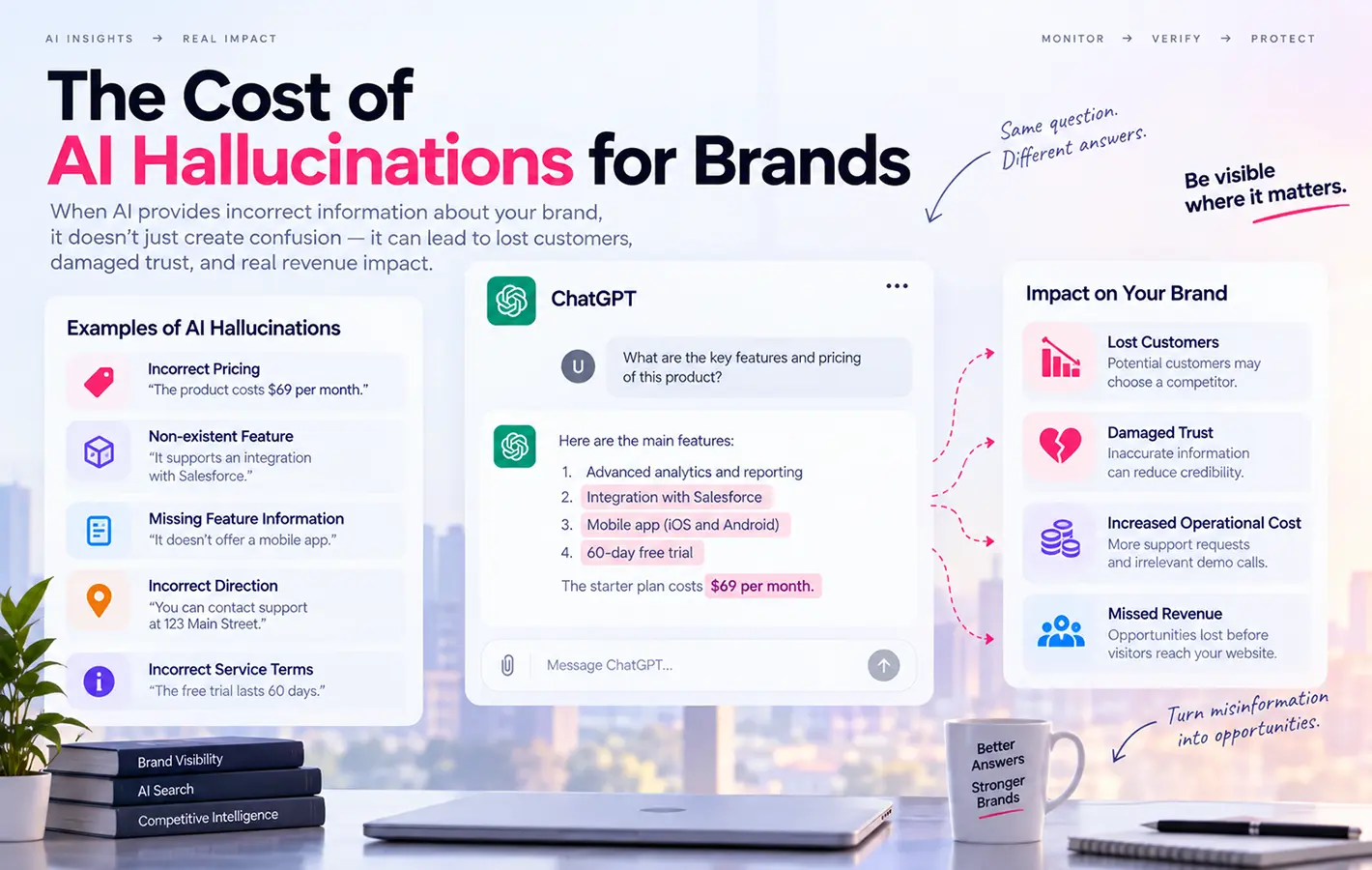
A potential customer asks ChatGPT about your product's pricing. The model answers instantly, with confidence, and in a well-formatted list. There is just one problem: the price it quotes is wrong, the integration it mentions does not exist, and the free trial length it states is not the one your team actually offers.
This is an AI hallucination — a generative model presenting fabricated or outdated information as fact. Unlike a typo on your own website, you cannot edit this answer. It lives inside a black box, and it may be shown to hundreds of potential customers before anyone on your team even notices it happened.
As AI assistants increasingly sit between your brand and the people trying to evaluate it, hallucinations stop being a curiosity and start being a business risk. This article breaks down where these errors come from, what they cost a brand, and how to build a process to catch them before they cost you a customer.
What an AI Hallucination Looks Like in Practice
Hallucinations are rarely random nonsense. They are usually specific, plausible-sounding claims that happen to be false. The most common patterns we see when monitoring brand mentions across AI assistants are:
- Incorrect pricing. "The product costs $69 per month," when the actual starter plan is priced differently or structured around usage tiers.
- Non-existent features. "It supports an integration with Salesforce," when no such integration has shipped or was ever planned.
- Missing feature information. "It doesn't offer a mobile app," when a mobile app has existed for over a year but simply wasn't present in the sources the model relied on.
- Incorrect directions or contact details. "You can contact support at 123 Main Street," pointing a customer to an address, phone number, or process that is out of date or entirely fabricated.
- Incorrect service terms. "The free trial lasts 60 days," when the real offer is shorter, longer, or conditional in ways the model omitted.
The unsettling part is consistency — or the lack of it. Ask the same question twice, on two different platforms, and you can get two different answers. A prospect comparing ChatGPT's answer with Perplexity's answer may see contradictory claims about your own product, with no way to know which one — if either — is correct.
Why Hallucinations Happen
AI assistants generate answers by predicting the most statistically plausible continuation of a prompt, not by looking up verified facts in a database your brand controls. Three structural causes drive most brand-related hallucinations:
- Stale training data. The model's knowledge has a cutoff date, so pricing changes, new features, and discontinued plans announced after that date are invisible to it.
- Thin or fragmented source material. When a model can't find clear, structured information about your product, it fills the gap with an inference based on similar products in your category.
- Conflicting third-party content. Outdated blog posts, abandoned comparison sites, and unofficial reviews often rank well in the sources an AI system pulls from, and the model has no reliable way to know they're stale.
None of these causes are under your direct control in the way a CMS typo is. That is exactly what makes monitoring, rather than one-time correction, the only durable response.
The Real Cost: How Misinformation Translates into Lost Revenue
A wrong answer from an AI assistant does not stay contained to that one conversation. It compounds across four areas of the business.
| Impact Area | What Happens | Why It Matters |
|---|---|---|
| Lost customers | A prospect compares AI-generated answers and picks a competitor based on inaccurate pricing or missing features. | The lost sale never appears in your CRM — there is no support ticket, no form fill, no trace. |
| Damaged trust | A customer discovers the AI's claim was wrong only after signing up, or worse, after a purchase decision. | Inaccurate information that traces back to your brand erodes credibility even though you didn't write it. |
| Increased operational cost | Support and sales teams field a rising volume of questions based on features, prices, or policies that don't exist. | Every misinformed inquiry consumes time that should go toward real customers. |
| Missed revenue | Opportunities are lost before a visitor ever reaches your website, because the AI answer itself was the deciding moment. | Traditional funnel analytics can't see a conversation that happened entirely inside someone else's chat interface. |
The common thread across all four is visibility. You cannot fix, dispute, or even measure a hallucination you don't know occurred.
Monitor, Verify, Protect: A Practical Response
Reacting to AI hallucinations requires the same discipline brands already apply to online reputation — just extended to a new surface.
Monitor. Track what ChatGPT, Claude, Perplexity, and Google AI Overviews actually say about your brand across your most commercially important queries — pricing, features, comparisons, and support. Treat this the same way you'd treat search rank tracking: continuously, not as a one-off audit.
Verify. When an answer is wrong, trace it back to a cause. Is it a stale training snapshot, a gap in your own published content, or an outdated third-party source still being cited? Each cause points to a different fix.
Protect. Close the gap with clear, structured, and frequently updated source material — pricing pages, changelogs, and comparison content written the way an AI system can extract it — and monitor the same queries again to confirm the correction actually took hold.
Same question, different answers is not a hypothetical risk; it's the default state of brand information across AI assistants today. Turning that misinformation into an opportunity starts with being visible where the answers are actually being written — and with Franixo, you can see exactly what AI assistants are telling your customers, before it costs you one.